First-party friendly fraud in ecommerce: A definitive guide
Half of merchants believe that consumers are a bigger threat to ecommerce than professional criminals. Discover out the types, signals and techniques of first-party fraud and abuse, and how to stop it.
20 October 2026
Your customers may pose just as much of a fraud threat as professional fraudsters. Or more.
What makes first-party fraud so difficult to tackle? The customer uses their real name, otherwise legitimate account and/or payment details. Their actions may look completely legitimate until the abuse is discovered.
But the consequences for merchants are very real and measurable. In fact, fraudulent chargebacks and refund abuse are reported to be the second and third most expensive types of fraud for merchants today.
What is first-party fraud?
Any and all fraud committed by a genuine customer using their own identity, account or payment details is first-party fraud – also known as consumer fraud and friendly fraud.
Unlike other forms of ecommerce fraud, there may be no stolen card, fake identity or compromised account to spot. The purchase, for all intents and purposes, looks normal.
The fraud arises from what the customer does next: They might falsely claim an order never arrived, dispute a genuine purchase with their bank or create several accounts to claim the same promotion.
These days, friendly fraud tends to be an alternative term to describe first-party fraud or customer fraud. Historically, the term has referred to fraudulent chargebacks specifically, perhaps because they were the most prevalent form of first-party fraud in the early days of ecommerce.
As other forms of first-party fraud such as refund and promo abuse became more prevalent, industry terminology has become less consistent and we’ve ended up using the terms “friendly fraud” and “first-party fraud” interchangeably.
In other words: Fraudulent refunds are friendly fraud. But not all friendly fraud is fraudulent refunds – or at least, there is no clear consensus.
For all intents and purposes, we use “friendly fraud” to refer to all first-party fraud in this article.
Not all chargebacks are first-party fraud
Another useful note here is that a chargeback itself is not evidence of first-party fraud. If stolen card details are used and the genuine cardholder disputes the transaction, the chargeback is legitimate and the underlying offense is third-party payment fraud.
When a chargeback is fraudulent (and thus constitutes first-party fraud), the genuine cardholder knowingly disputes a transaction that they themselves authorized, or misrepresents to their bank the quality of an item or service, hoping to recover their money.
This chargeback example shows how similar outcomes for a merchant can stem from different types of fraud, depending on who authorized the transaction and who was behind the deception. Let's take a look at a breakdown.
First- vs second- vs third-party fraud
Differentiator
First-party fraud
Second-party fraud
Third-party fraud
Who is committing the fraud?
Cardholder, known consumer.
Person in contact with the cardholder, known consumer.
Professional fraudster.
Identity known?
Identity known to the merchant.
Identity not known to the merchant but known to the cardholder.
Identity not known to the merchant nor to the cardholder.
How it works
A genuine customer acts alone to defraud the merchant, using their own identity, account and payment details.
A genuine customer knowingly enables or helps another person to commit fraud.
A fraudster who is hiding their own identity commits fraud, often using the identity or card of someone who has not authorized this.
Example
e.g. A customer receives an order but then falsely claims it never arrived.
e.g. A cardholder lets an accomplice use their account, for example to act as a money mule.
e.g. A person uses stolen card details to make an unauthorized purchase.
How big of a threat is first-party fraud today?
First-party fraud is a major threat. In Ravelin’s 2026 poll of payments and fraud professionals, 43% reported an increase in fraudulent behavior from first parties over the previous 12 months, with chargeback fraud and refund abuse the second and third most costly fraud types respectively.
In fact, when we asked ecommerce merchants who they believe poses the biggest threat to their bottom lines, opinion was noticeably split in half: One third (34%) said that consumers are a bigger threat than professional fraudsters, while a further 31% said that abusive consumers and professional fraudsters pose the same levels of threat to businesses.
Explore the latest Global Fraud Trends
Read 2026 findings from surveying 1,500+ fraud and payments professionals working in ecommerce in 10 countries in our latest report.
Consumers themselves admit to this, based on additional research. In a survey of more than 6,000 shoppers also conducted by Ravelin, 27% admitted to abusing merchant refund policies in the last year – with 6 in 10 of those doing it as often or more often than before.
First-party fraud and AI
AI is exacerbating the problem. Two-thirds of merchants have received AI-generated fake refund evidence, and one-third named AI as their biggest fraud-related challenge for the year ahead.
To add insult to injury, 55% of consumers told Ravelin that AI makes refund abuse “feel less wrong”.
Whether first-party fraud can be curtailed now depends on how easy merchant policies are to exploit, how much AI lowers the barrier to entry, and how effectively repeat behavior is detected and prevented.
Types of first-party fraud
First-party or friendly fraud can take several forms according to which part of the customer journey is being impacted. In ecommerce, the main risks tend to appear through chargebacks, refunds and promotions.
1. Fraudulent chargebacks
Fraudulent chargebacks occur when a customer makes a genuine purchase, receives the product or service, and then files a false dispute with their bank.
A chargeback is a claim made to a card issuing bank that a customer is owed their money back.
In the case of a fraudulent chargeback in particular, a customer may claim one of the following when they are not true:
That the transaction was unauthorized
That the goods never arrived (item-not-received fraud)
That the goods they received did not match the product description
etc
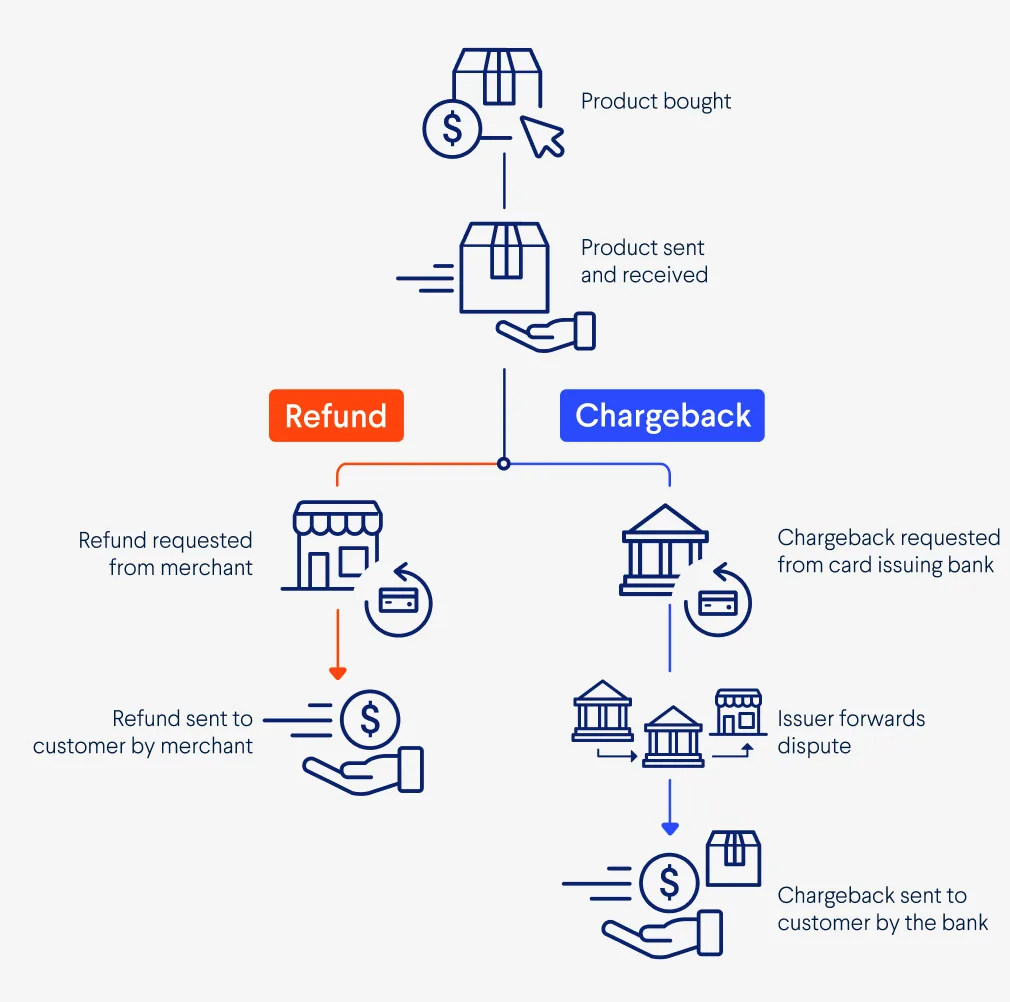
Note that chargeback abuse differs from refund abuse in who the customer requests money from: A chargeback request is always filed with the card-issuing bank, while a refund request is filed with the seller merchant.
2. Refund abuse
Refund abuse involves a customer exploiting a merchant’s refund policy to illegitimately obtain money, goods or both.
One customer may falsely claim that an item never arrived or that it arrived damaged when it wasn’t. Another may return a different item or send an empty box back to the merchant and hope the refund is processed before the return is inspected.
Similar tactics can also be employed by professional fraudsters at scale, where the activity is better described as organized refund fraud rather than first-party refund abuse. The difference, as we saw above, is that professional fraudsters typically hide their true identity.
wardrobing (returning clothes after wearing them),
serial returning (returning items so excessively that the merchant makes a loss)
reselling (where someone is buying cheap stock to resell against merchant policies, and then attempts to return any unsold items)
etc
3. Promo abuse
Promo abuse becomes first-party fraud when a genuine customer misuses discounts, vouchers, referral schemes, introductory offers or other promotional opportunities for their own gain – typically going against the merchant’s terms and conditions, or finding loopholes in them.
An example is multi-accounting, where one person creates several accounts to claim the same introductory offer more than once. And like refund abuse, organized fraud groups can use the same tactic at scale.
First-party fraud can take a different route based on where the customer seeks to recover their money. Refund abuse goes through the merchant, while a fraudulent chargeback goes through the card issuer.
Here’s how each typically unfolds:
Refund abuse
A customer places an order using their account and payment details.
The merchant ships the order.
Delivery is completed.
The customer claims the shipment never arrived, arrived damaged or contained the wrong item.
The merchant issues a refund or replacement.
If the claim worked, the customer may repeat the process or increase the value of future claims.
Fraudulent chargebacks
A customer makes a legitimate purchase and receives the item.
They dispute the payment through their card issuer, falsely claiming that they didn’t authorize the transaction, never received the goods, or another similar reason.
The issuer raises the dispute and passes it through the card network to the merchant’s acquiring bank or payment provider.
The merchant is notified and decides whether to accept the chargeback or challenge it with supporting evidence.
If the dispute succeeds, the customer receives their money back and retains the item in question.
Promo abuse
This type of friendly fraud varies by the specifics of the promotion being abused.
Generally speaking, it can involve the following:
A customer discovers, or hears about, a loophole in a merchant's promotion.
They take advantage of that promotion.
They create a new account.
They take advantage of the same promotion with the new account.
They create another account.
And so on. If the policy being exploited is a referral bonus or offer, the customer may create new accounts to make ita ppear like they have referred a lot of legitimate new customers.
First-party fraud has become easier to attempt (and arguably more tempting) as more and more of the customer journey has moved online, and as merchants try to become as competitive as possible with their online presence.
Refunds can often be requested with little friction, while promotions and automated customer service are designed to make legitimate transactions as smooth as possible. However, those same systems can also be abused.
At the same time, advice on how to exploit merchant policies is becoming easier to find, or even stumble upon. Social media and dark web communities share refund methods and discuss which claims are most likely to succeed.
Fraud-as-a-Service (FaaS) takes this idea one step further, with professional fraudsters offering to obtain refunds for genuine customers in exchange for a cut of the proceeds.
This puts more pressure on merchants to determine which claims deserve closer scrutiny. Return and refund abuse prevention solutions and strategies can help ecommerce fraud teams better understand the nature of a claim and discourage abuse without creating unnecessary friction for good customers.
Ravelin has found that 56% of frequent first-party fraudsters use AI, while 25% of all refund abusers used AI to find refund policy loopholes or learn how to commit fraud in the first place.
The democratization of generative AI has led to the barrier of entry being lower than ever. It’s now easier to create or edit images that falsely make a product appear damaged, defective or faulty in some way, when in reality it’s not.
How to detect first-party fraud
First-party fraud is easier to uncover when merchants combine several sources of evidence rather than relying on one check or data point. It’s important to look at and analyze an account’s overall behavior and history rather than individual actions.
What’s more, in the case of first-party fraud, identity-focused fraud detection solutions cannot be helpful: You may know with certainty who this person is, but what does it matter if they’re still defrauding you?
1. Look at the account, not just the transaction
An account-centric approach adds context to a shopper’s actions through a variety of data points, such as:
Previous orders and claims
Account age
Spending history
Connected accounts and devices
etc.
These are the details that enable merchants to differentiate typical from atypical customer behavior.
Graph network link analysis such as Ravelin’s Connect can also reveal hidden relationships between accounts that share certain characteristics such as device, address or payment method. This can be useful in first-party fraud when consumers attempt multi-accounting, or for locating clusters of these amateur fraudsters who know each other and teach each other techniques.
2. Use behavioral data and machine learning AI
Ravelin looks at how an account behaves and compares it with patterns from known fraudsters and good customers for that merchant. This can help surface suspicious activity even when the account is new or there is little history to work with.
The reason this works so well for first-party fraud is because the customer often uses their real identity and payment details. An identity check may not tell the merchant much, but the way the account behaves can still indicate abuse.
Importantly, real-time risk scoring gives merchants a chance to intervene before a suspicious customer gets their money back. In fact, with solutions that protect the customer journey end-to-end, you can be incredibly proactive – blocking fraudulent behavior at checkpoints even before the fraud happens.
The specifics, of course, can be tweaked to each merchant’s risk appetite. Instead of treating every refund request the same way, higher-risk claims can be subject to additional checks while straightforward requests from good customers are processed without additional friction.
4. Give opportunists a reason to change
Some customers are closer to opportunistic fraudsters than to committed criminals. In these cases, nudges, warnings and reduced access to automated refunds or promotions can discourage further abuse without immediately resorting to a ban.
In fact, nudging consumers who can be “rehabilitated” was one of the key pieces of refund abuse advice from veteran fraud fighters in our discussion panel. And it all starts with data. Your own data processed with ML will show you which consumers are dipping their toes in fraud but likely to change and which should probably be banned outright.
5. Improve the experience of good customers
Exceptional fraud prevention solutions don’t focus on blocking fraud but on enabling as much safe traffic as possible – because they align with the real goals of a merchant or online marketplace.
In fact, Ravelin’s solutions empower you to serve your good customers better than before, making their journeys smoother and more satisfying to earn their loyalty and good reviews.
First-party fraud patterns & signals
But how do you know you have a first-party problem in the first place? And what evidence do merchants need to consider when deciding whether a request or claim should be approved, reviewed or challenged?
Useful signals of friendly fraud include:
Repeated claims or a narrow claim pattern: Refunds or disputes make up an unusual proportion of the order history, or the customer repeatedly makes item-not-received or damaged-item claims that do not follow established patterns with your customer base.
Suspicious timing: For example, claims that start soon after account creation, first purchase or delivery.
Unusual increase in promo claims: For promo abuse, a sudden rise in usage that does not align with marketing campaigns could indicate that a consumer has found and shared a loophole in your promotional programs.
Escalation: Claims tend to become more frequent or valuable over time for that customer.
Address manipulation: Address jigging uses variations of the same delivery address to make accounts appear unrelated, such as “123 Smith Avenve” instead of “123 Smith Avenue”.
Changing tactics: A customer rotates claim reasons, accounts or channels.
Conflicting evidence: A claim doesn’t match carrier, warehouse or delivery data.
Negative lifetime value: Repeat abusers will almost always have very low or negative lifetime value as customers and a low rate of goods kept vs returned goods.
This data is helpful in catching some of the most common first-party fraud. What’s more, it will prove helpful if an attempt at a refund becomes a chargeback problem, as it would assist in challenging that chargeback.
Protecting ecommerce from first-party fraud
First-party fraud covers far more than the occasional dishonest chargeback. Refund abuse, promo abuse and false disputes can all come from genuine customers with legitimate accounts and payment details.
Merchants therefore need to assess individual customer behavior across the customer journey and in real time – and respond appropriately based on the type and severity of abuse.
Importantly, AI-native, data-focused fraud solutions such as Ravelin’s solve the potential of “insulting” good customers along the way.
By understanding what honest and dishonest behavior is for your specific customer base, we empower you to serve your honest customers better while curbing first-party fraud.
Learn how to stop them
Get into the mind of a refund abuser and learn how to stop them: findings from speaking to 6200+ consumers.
Broadly speaking, yes. "Friendly fraud" originally used to describe dishonest chargebacks as that was the only recognized type of first-party abuse in ecommerce at the time, but the term is also used more broadly for first-party abuse such as refund and promo abuse.
If you've noticed some inconsistency in the terminology, this is why.
Why should merchants stop customer fraud?
According to the latest data, 43% of fraud and payments professionals reported an increase in first-party fraud, while chargeback fraud and refund abuse ranked among the costliest fraud types.
AI is also helping customers find policy loopholes and create convincing evidence for false claims, which makes an already expensive form of fraud easier to commit.
Customer fraud directly eats into the bottom lines of merchants both directly (by causing monetary loss or reducing sales) and indirectly (by affecting card scheme monitoring rates, encouraging repeat offenders, etc).
Will customers stop shopping with me if I block abusive behavior?
No. Quite the opposite – customers appreciate companies that are proactive with online risk. At least half of consumers say that efficient protection reassures them to buy from you.
A robust fraud prevention solution minimizes false positives and enables you to serve good customers better.
When is a chargeback friendly fraud?
A chargeback request (or dispute) becomes friendly fraud when the genuine cardholder is lying about what happened to recover the money. This includes saying they didn’t authorize a transaction they actually authorized, or misrepresenting the quality of an item they received.
If stolen card details were used without the cardholder’s knowledge, this is third-party fraud instead.
It’s true that in ecommerce, there is good reason to try to prevent as many chargebacks and disputes as possible – be they genuine or friendly fraud. But it's also useful to merchants to make the distinction so they are better protected.
What constitutes suspicious customer behavior in ecommerce?
Warning signs include unusually frequent claims, low kept rate (percentage of kept vs returned items), gradually increasing claim values, repeated use of the same claim reason, address manipulation, and activity that conflicts with delivery or account data.
Suspicion should increase if several of these signals appear together or recur across multiple interactions.
Why is first-party fraud difficult to detect?
First-party fraud is difficult to detect because the customer, account and payment details are often genuine, so the purchase may pass normal fraud checks.
The abuse only becomes apparent later, when the customer makes a false refund claim, files a dishonest chargeback or exploits a promotion.
Driven by a fascination with how technology can solve complex human problems, Sam Fitzpatrick studied Computer Science at University College Cork, where…