On March 5th, 2026, the fraud and payments community from far and wide came together at RavCon – Ravelin's annual conference dedicated to fraud and payments in ecommerce.
At this year's event, we welcomed hundreds of attendees from across our clients, partners, friends, and the wider fraud and payments community.
Attendees were also treated to live end-to-end agentic demos featuring a real shopfront from Ravelin's tech team. They showcased agentic shopping, agentic signals in Ravelin's Dashboard as well as how easily an agent can be set up to commit fraud.
With accessibility in mind, for the first time this year, we introduced live captioning for our sessions, created by a human transcriber from MyClearText, to ensure all our attendees can watch and participate on equal footing.
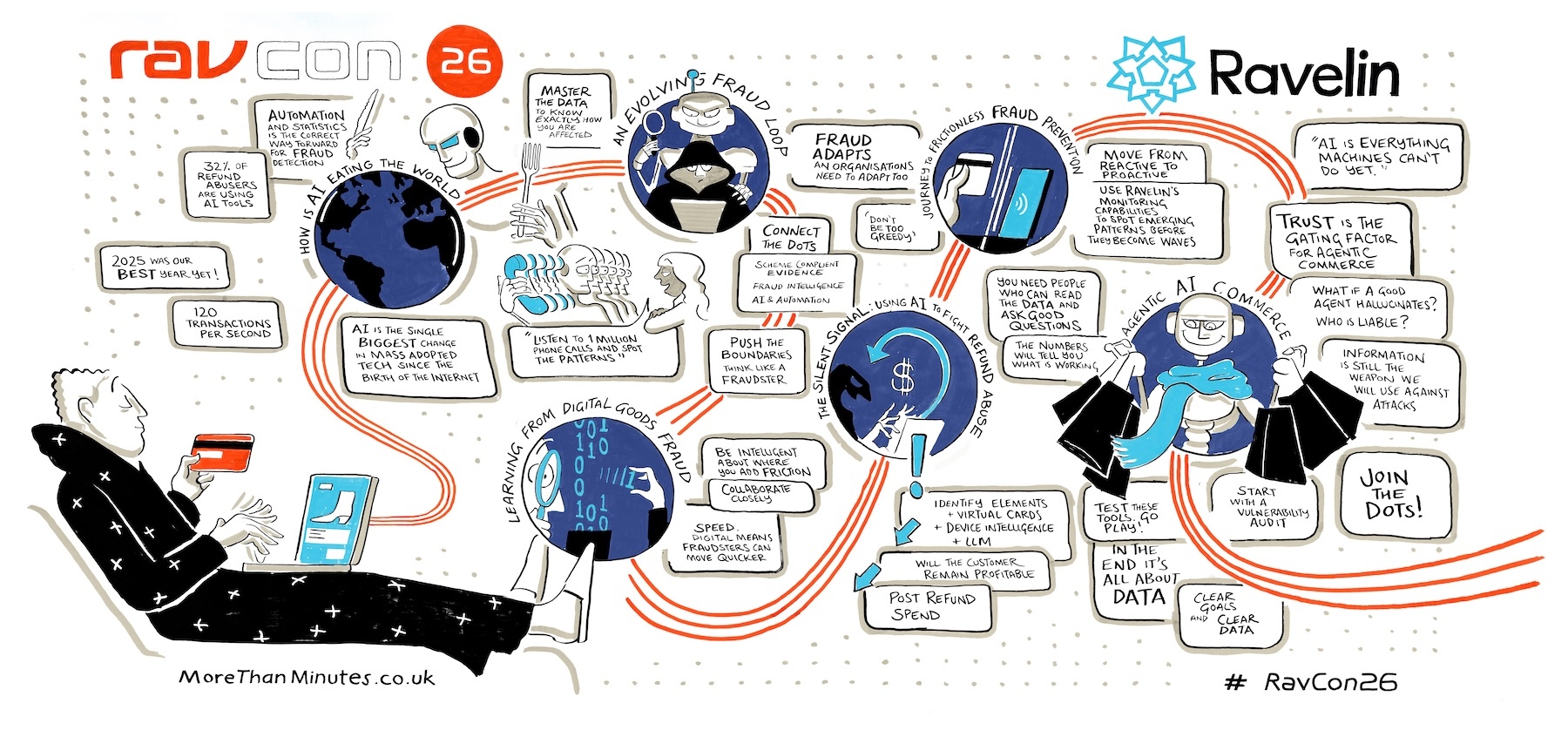
Other updates included a sketch artist duo and a visual minutes artist, who captured the day in illustration form, on the spot. In fact, you can see the resulting illustration at the bottom of this article.
What we learned at RavCon 26
On the stage of London's Pan Pacific Ballroom, an iconic range of tech and commerce leaders generously shared their stories and insights:
Tech analyst Benedict Evans delivered the fascinating keynote titled "AI Eats the World".
Back Market's Lea Polge and Benjamin Binaud spoke about the link between refund abuse and chargebacks in "An Evolving Fraud Loop".
Anna Collier from Fanvue and Scott Wels from Spotify discussed digital goods fraud – and what we can learn from it – with Ravelin's Jamie George.
Ravelin's own Himayak Dhar and Jerome Titus explored using LLMs to fight refund abuse, including identifying fake names and address-jigging.
Benjamin Louche from iconic European brand ADEO spoke about designing a scalable fraud detection framework across markets.
Worldpay's Haydon Croker and Ravelin's Jono MacDougall explored everything agentic commerce – both enabling it and safeguarding from potential risks.
There was a lot that we learned at Ravelin's fraud and payments event this year. Let's join the dots to summarize the experts' advice from the day:
1. Understand what agentic means – for both sides
Agentic AI commerce is here and while the contenders for dominant protocol battle it out, fraudsters have become early adopters, figuring out ways to deploy agents against companies. And if it goes wrong, who is liable? What if a good agent hallucinates?
It's great to prepare for agentic commerce as a merchant, but make sure you're also prepared for agentic fraud, agentic refunds, and agentic chargebacks.
2. Work on communication and collaboration
The old way of managing fraud needs to change. Fraud teams cannot afford to remain siloed. Talk to payments, customer service, warehouse teams who handle #returns – you'll get buy-in but you'll also get useful insights.
Share information, understand fraud and abuse together, collaborate on solutions: This is how you benefit both the business and its customers.
3. Observe how fraud is shifting and scaling
With the advent of GenAI, the tech barrier to large-scale fraud operations is all but removed for criminals. Refund requests are now powered by AI. If denied, they become chargeback requests powered by AI. Synthetic identities are easily created en masse. Criminals can automate and scale more than ever before – and this makes them more difficult to catch.
Fraud signals are shifting, and we ought to be vigilant. Spot the patterns and figure out what this means for your company sooner rather than later.
4. Master the data
Ravelin has advocated for the need to understand data in fraud prevention for more than a decade, but this need is only going to become more important over time. The numbers will tell you what is and what isn't working. Use this to your advantage.
Make sure you look at all relevant data too, going beyond fraud rates to examine return rates, lifetime value and customer behavior as a whole, for example.
5. Go play like a fraudster!
As a fraud fighter, it's useful to try to think like a fraudster. Follow tech developments. Test these new tools – and your own defenses.